A LITTLE LOOK INSIDE
Lifestyle
Everyday Adventure
A more curious way to live.
Rediscover your neighborhood, reconnect with your curiosity, and find inspiration close to home through a collection of thoughtful everyday adventures.
- 10 practical chapters
- 10 reusable worksheets
- Four-week practice plan
- Format
- PDF ebook
- Length
- 62 pages
- Language
- English
- Price
- US$10.00
Checking availability…
Explore other booksWHAT YOU RECEIVE
Everything included with your ebook.
A complete digital edition designed for reading, reference, and practical use.
BEYOND THE LAST PAGE
A guide you can put to work.
Find your starting point
Begin with “Give the familiar a question”. Read the lesson before moving into the practical session.
Make one useful attempt
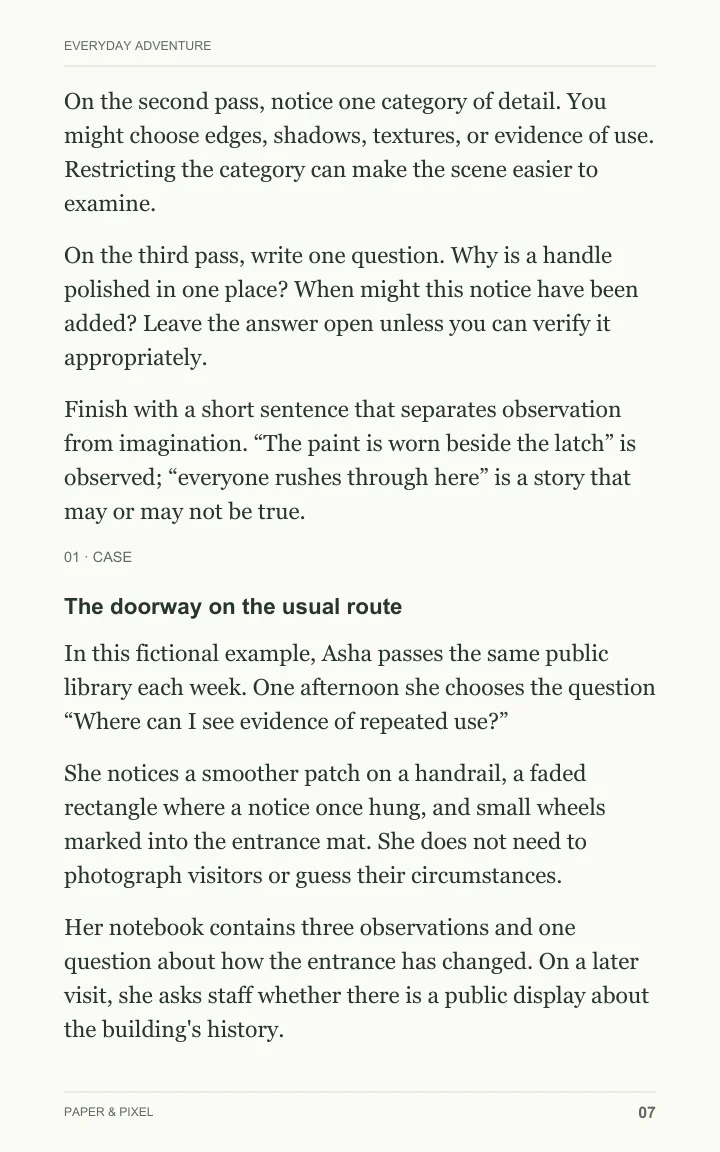
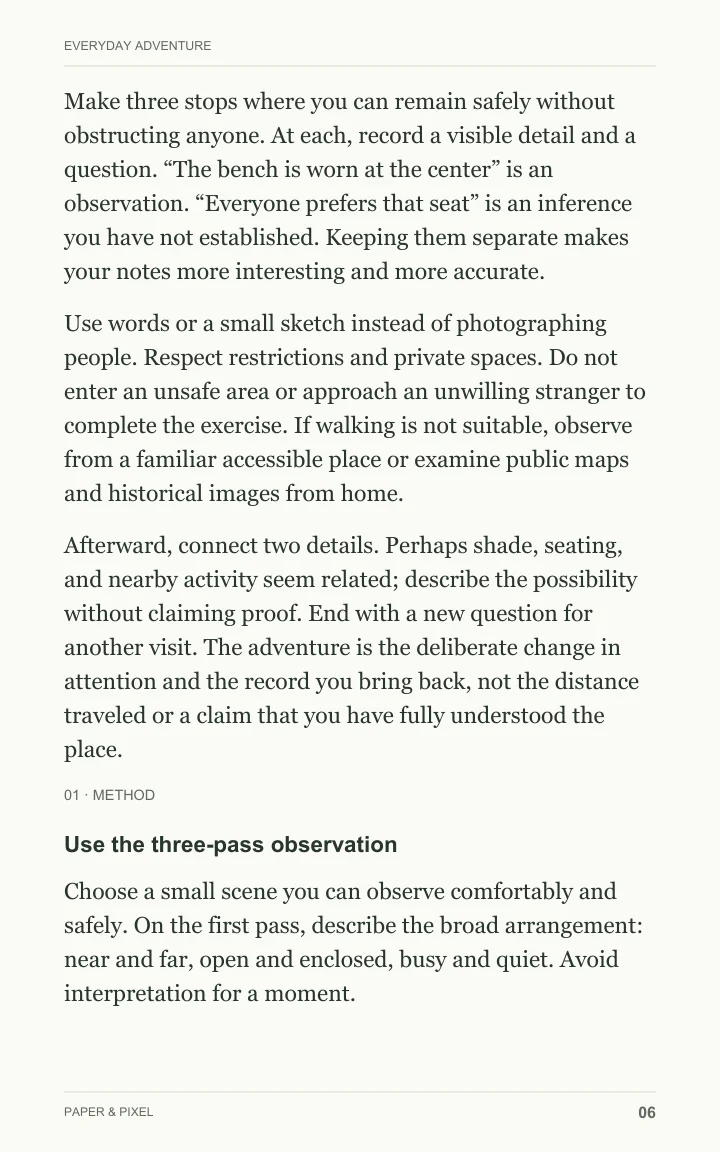
Observe a familiar scene in three passes: the broad arrangement, one category of detail, and an unanswered question.
Keep what helps
Use the 10 worksheet pages to record decisions, then return to the four-week practice plan when you want a little structure.
Who this ebook is for
Curious readers looking for modest, adaptable explorations close to home, including seated and home-based options.
Revised and expanded edition. Ten chapters, five in-depth worked lessons, an integrated practical project, a subject glossary, ten worksheets, and a four-week plan.
Read an excerpt
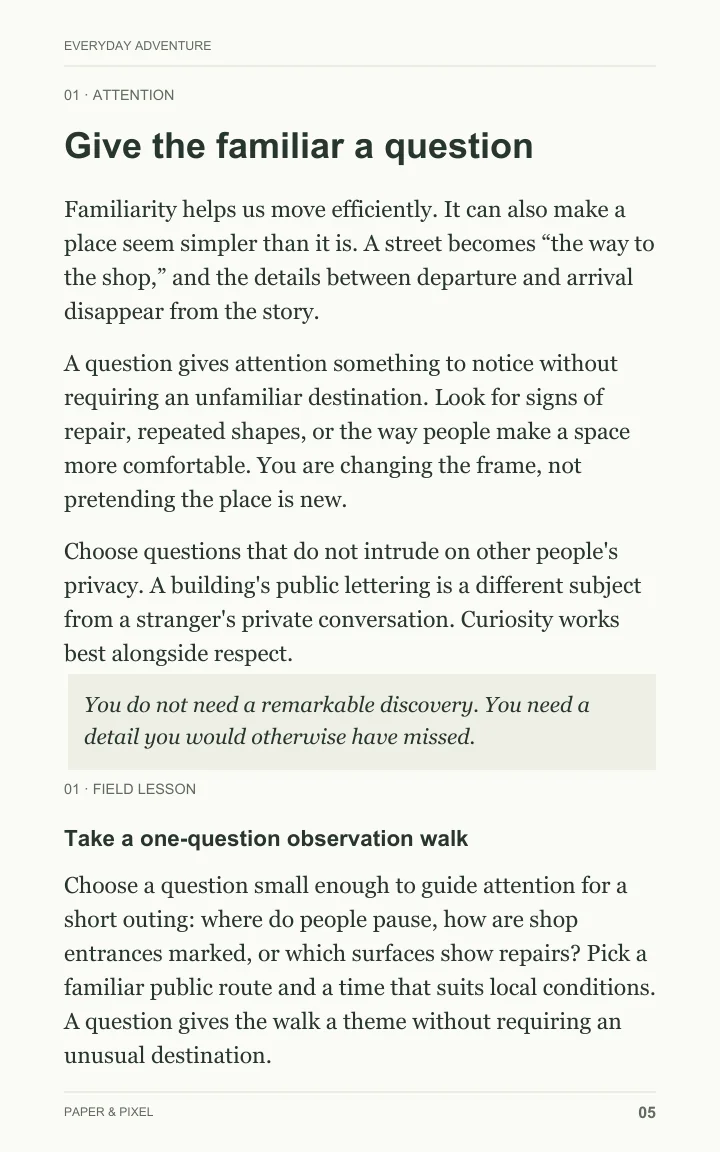
Familiarity helps us move efficiently. It can also make a place seem simpler than it is. A street becomes “the way to the shop,” and the details between departure and arrival disappear from the story.
Inside the book
- Give the familiar a question
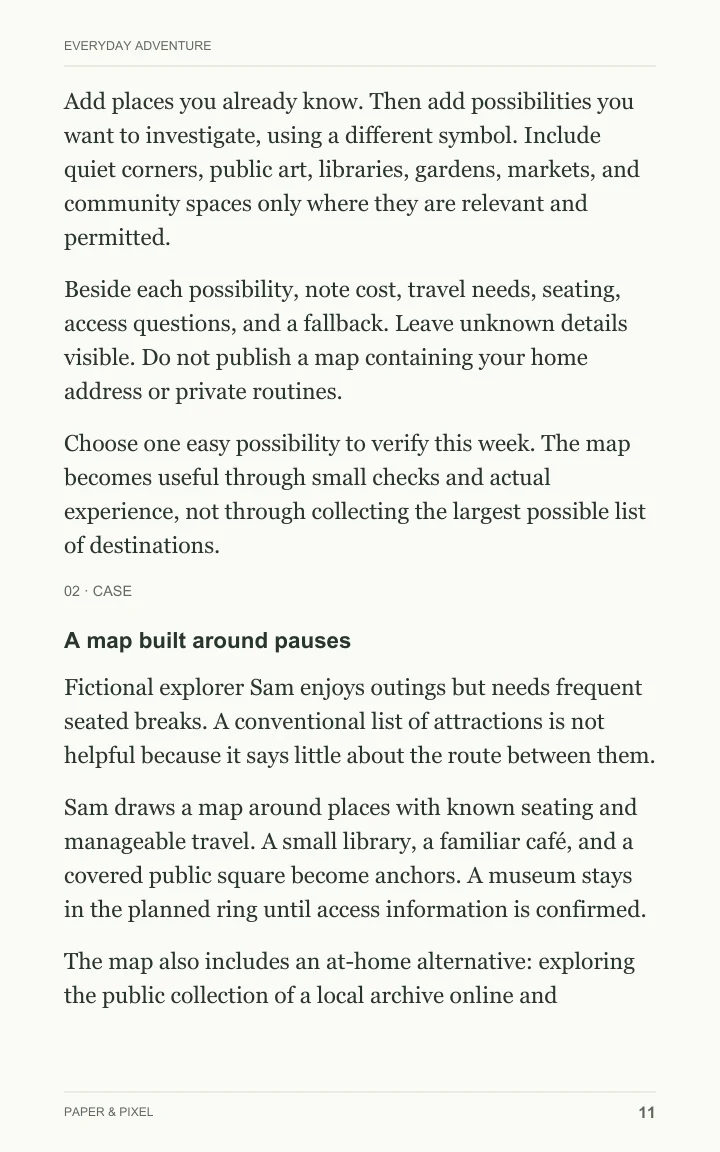
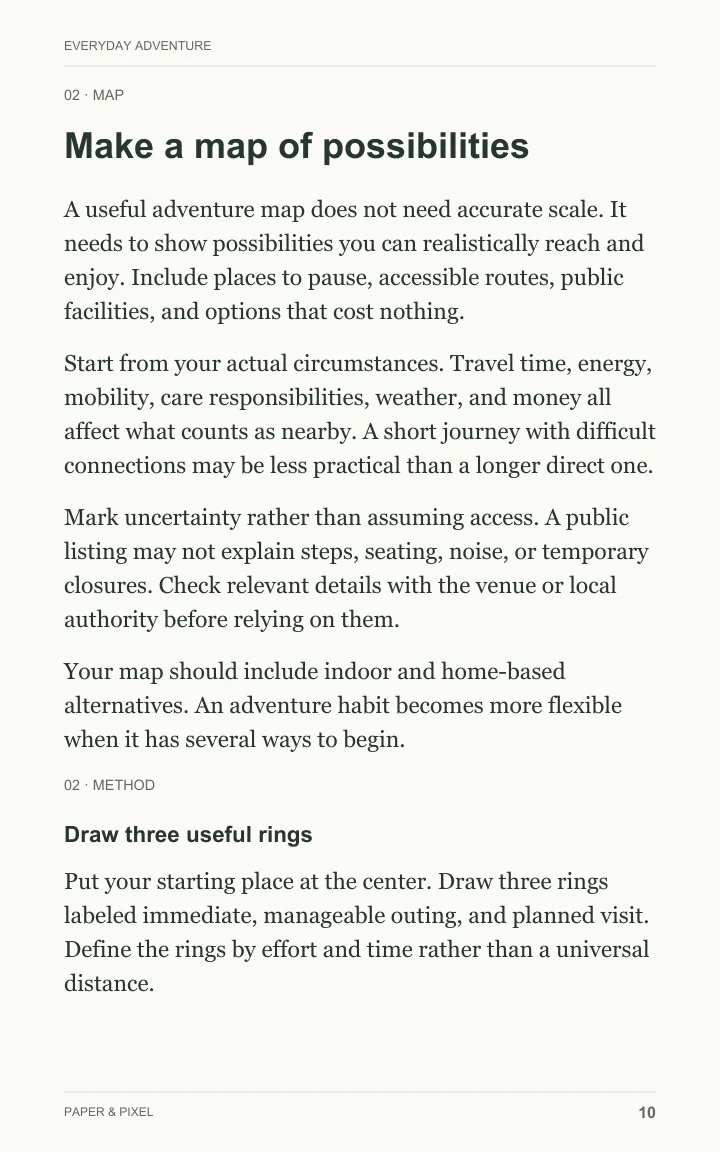
- Make a map of possibilities
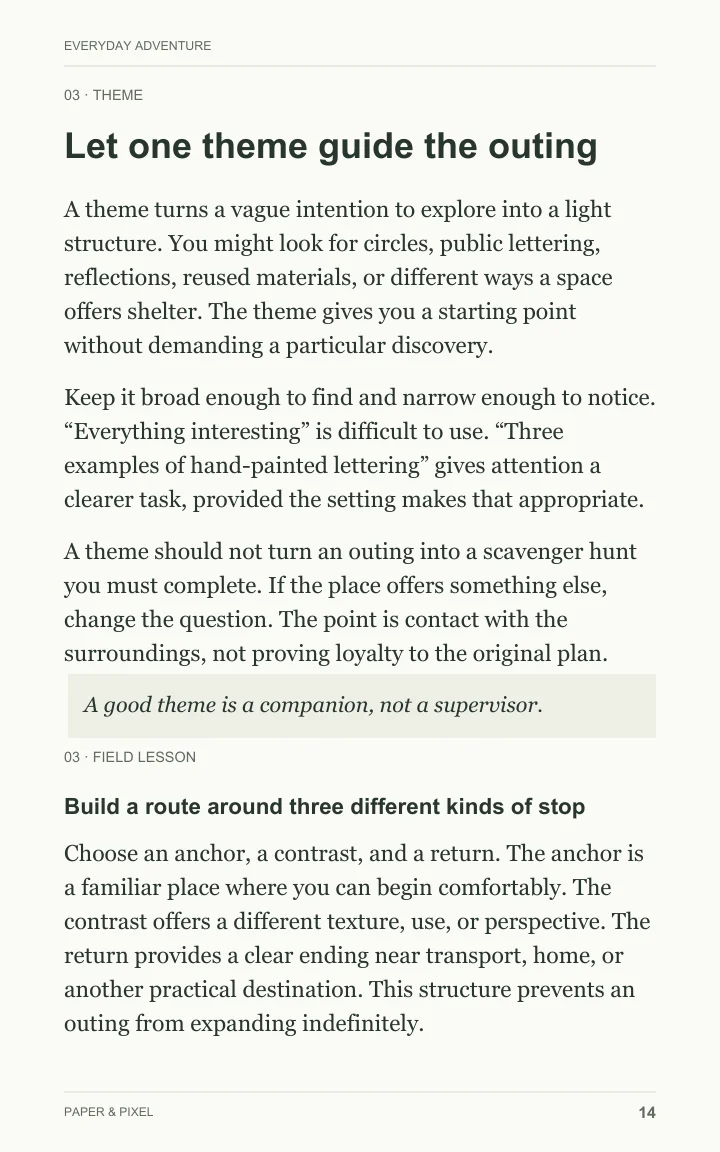
- Let one theme guide the outing
- Set a generous boundary
- Choose how to explore together
- Be a guest in shared places
- Turn an observation into a small creation
- Let the conditions change the plan
- Keep a record that belongs to you
- Build a menu of repeatable adventures
Also included: 10 reusable worksheets and a four-week practice plan. Page counts include the cover, front matter, worksheets, and editorial notes.
Worked lessons and a complete project
The expanded edition develops the chapter ideas through these detailed lessons:
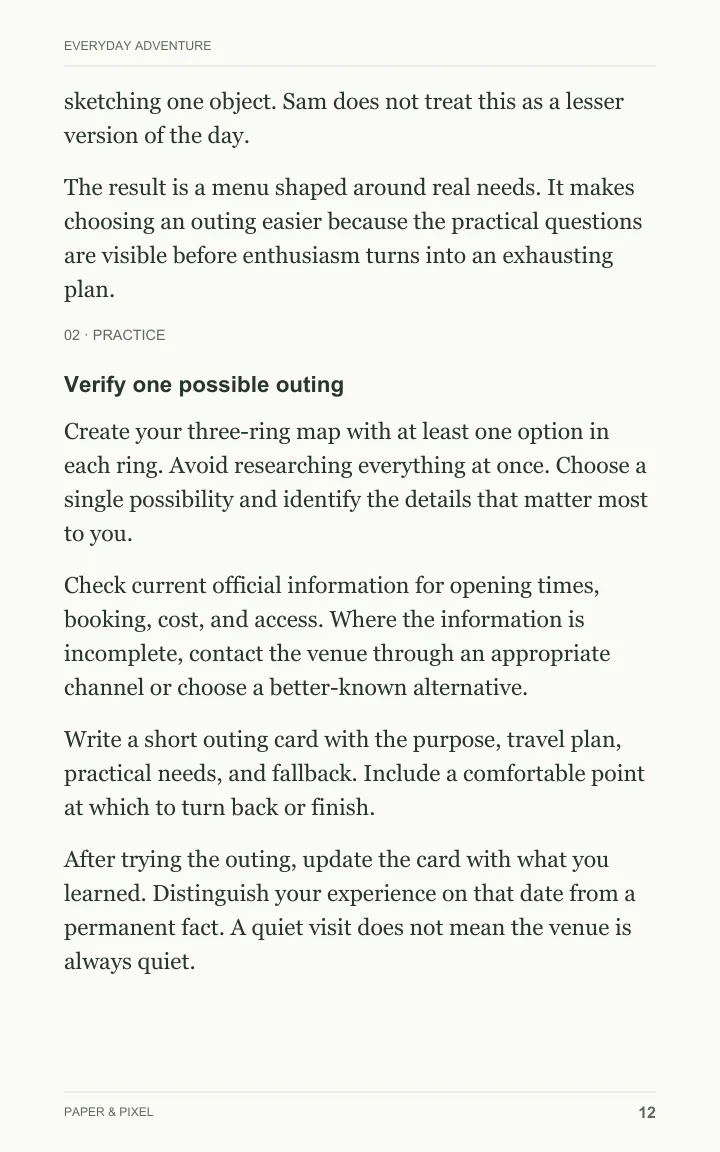
- Take a one-question observation walk
- Build a route around three different kinds of stop
- Plan a shared outing without assuming shared preferences
- Turn field notes into a small finished artifact
- Keep a field notebook you can use again
Apply the ideas together
- Design a small exhibition of an ordinary place
- Collect details and distinguish their meanings
- Arrange and share the collection thoughtfully
A subject glossary provides a quick reference while you work.
A small exercise to begin
Observe a familiar scene in three passes: the broad arrangement, one category of detail, and an unanswered question.
Edition and reading notes
Original editorial content. The PDF uses a fixed page layout with printable worksheet lines; it is not a fillable form or reflowable EPUB. No independent specialist review is claimed. Read our editorial policy.
Keep following the thread.
Lifestyle
A Table for You
Simple food. A happier everyday.
Read the sample & details ↗READER PERSPECTIVES
The reading experience.
Busy professional
“The structure feels calm and easy to follow. I would use the first worksheet before beginning a new project.”
Independent creator
“The strongest part is how quickly the ideas become usable. The chapter on “Make a map of possibilities” would be especially useful in a busy week.”
Curious beginner
“This reads like a thoughtful workshop rather than a long lecture. It feels designed to revisit, not just finish once.”
Weekend learner
“The chapter sequence makes the subject feel approachable. The exercise is specific enough to try without extra tools.”
Practical planner
“The examples keep the advice grounded in ordinary decisions. A reader could comfortably complete this in short sessions.”
Reflective reader
“The worksheets give each chapter a clear next step. The examples make the limits of the advice easy to understand.”
Small-team lead
“The tone is encouraging without promising an instant transformation. I like that the book leaves room for personal judgment.”
Habit builder
“The fixed-page design makes this pleasant to read and annotate. The printable pages would make a useful working companion.”
Visual thinker
“The short sections work well for focused reading sessions. The progression from observation to action feels natural.”
Note-taking reader
“The book respects the reader’s time and still explains the reasoning. This would suit someone who wants a concrete starting point.”
Self-directed learner
“The practical prompts help turn reflection into a useful experiment. The language stays clear even when the subject becomes detailed.”
Project starter
“The final project brings the separate lessons together clearly. The closing practice gives the book a satisfying sense of direction.”