A LITTLE LOOK INSIDE
Business & Money
Smart Money Moves
Build a life of financial freedom.
Understand your money, create a thoughtful budget, and discover the foundations of long-term financial planning. Educational content, not personalized financial advice.
- 10 practical chapters
- 10 reusable worksheets
- Four-week practice plan
- Format
- PDF ebook
- Length
- 66 pages
- Language
- English
- Price
- US$10.00
Checking availability…
Explore other booksWHAT YOU RECEIVE
Everything included with your ebook.
A complete digital edition designed for reading, reference, and practical use.
BEYOND THE LAST PAGE
A guide you can put to work.
Find your starting point
Begin with “A balance is a moment, not a plan”. Read the lesson before moving into the practical session.
Make one useful attempt
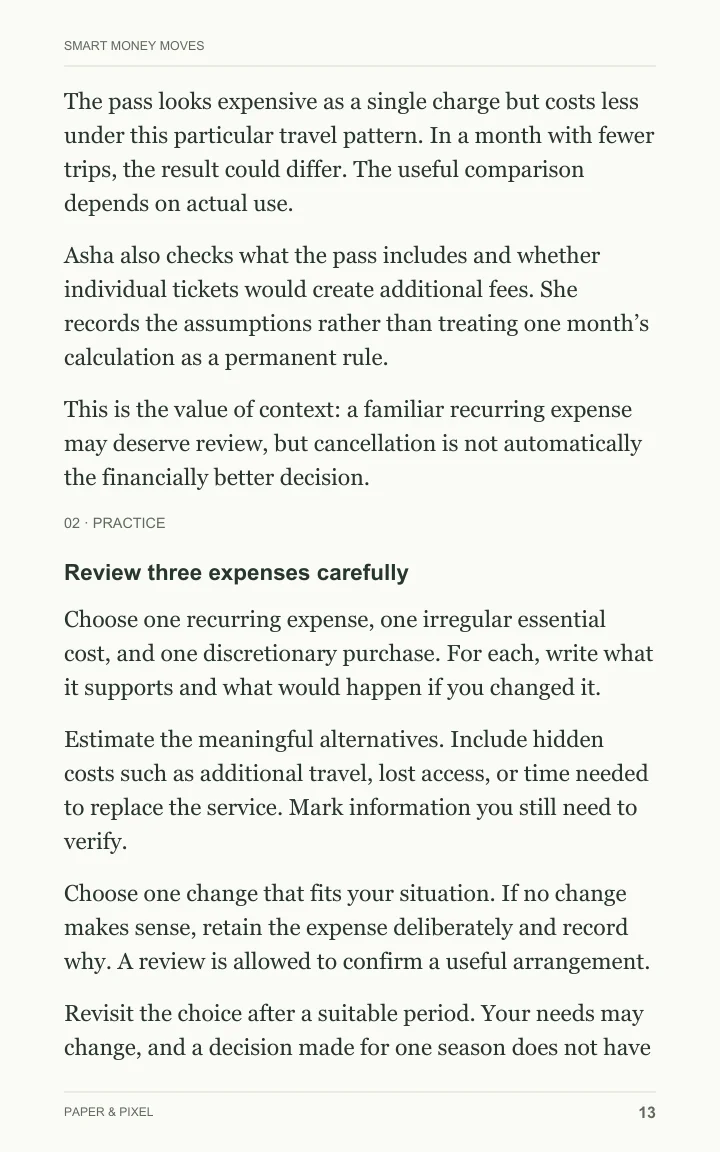
Map expected income and committed expenses over the next two weeks, marking uncertain amounts instead of treating them as facts.
Keep what helps
Use the 10 worksheet pages to record decisions, then return to the four-week practice plan when you want a little structure.
Who this ebook is for
Beginners who want to understand their personal money picture and identify questions to research before making financial decisions.
Revised and expanded edition. Ten chapters, five in-depth worked lessons, an integrated practical project, a subject glossary, ten worksheets, and a four-week plan.
Read an excerpt
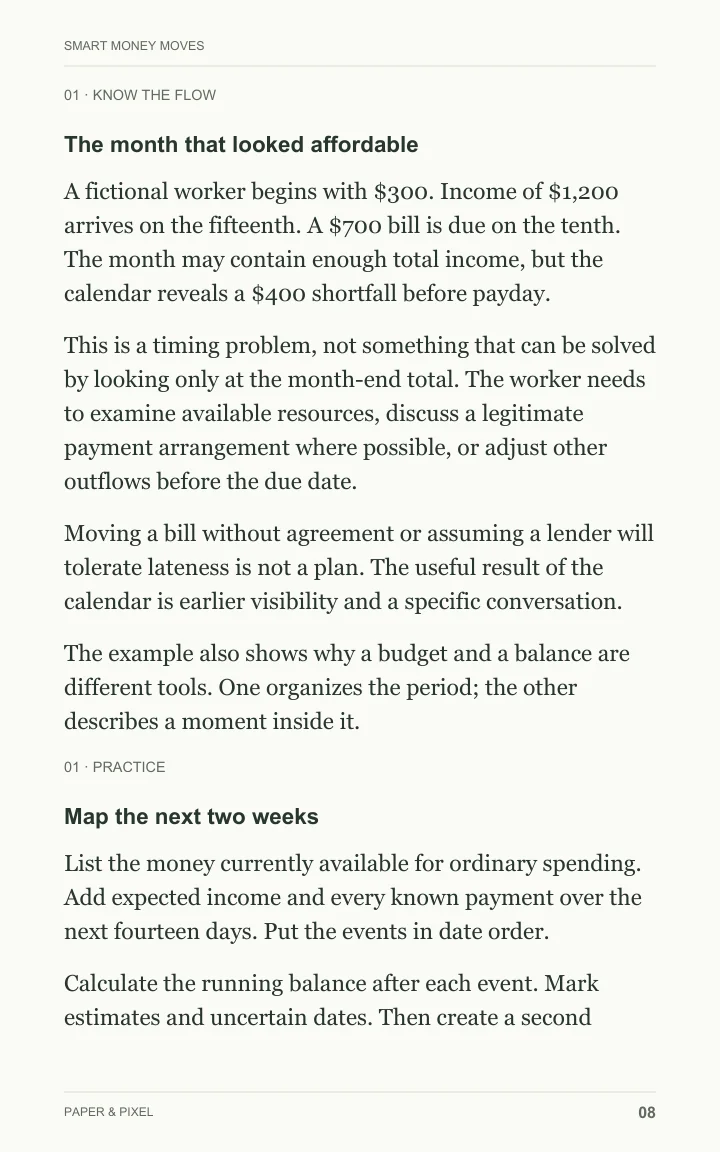
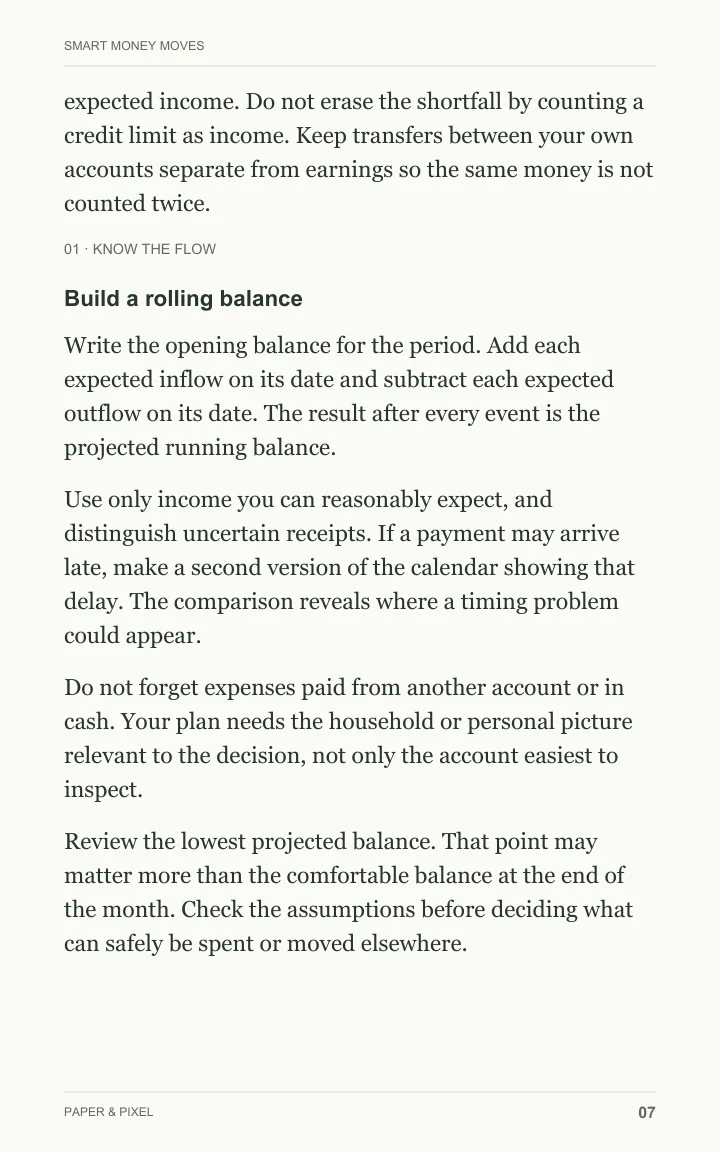
An account balance shows money available at a particular moment. It does not show every claim already waiting against that money. Rent, a loan payment, a shared bill, or an annual renewal may be due before the next income arrives.
Inside the book
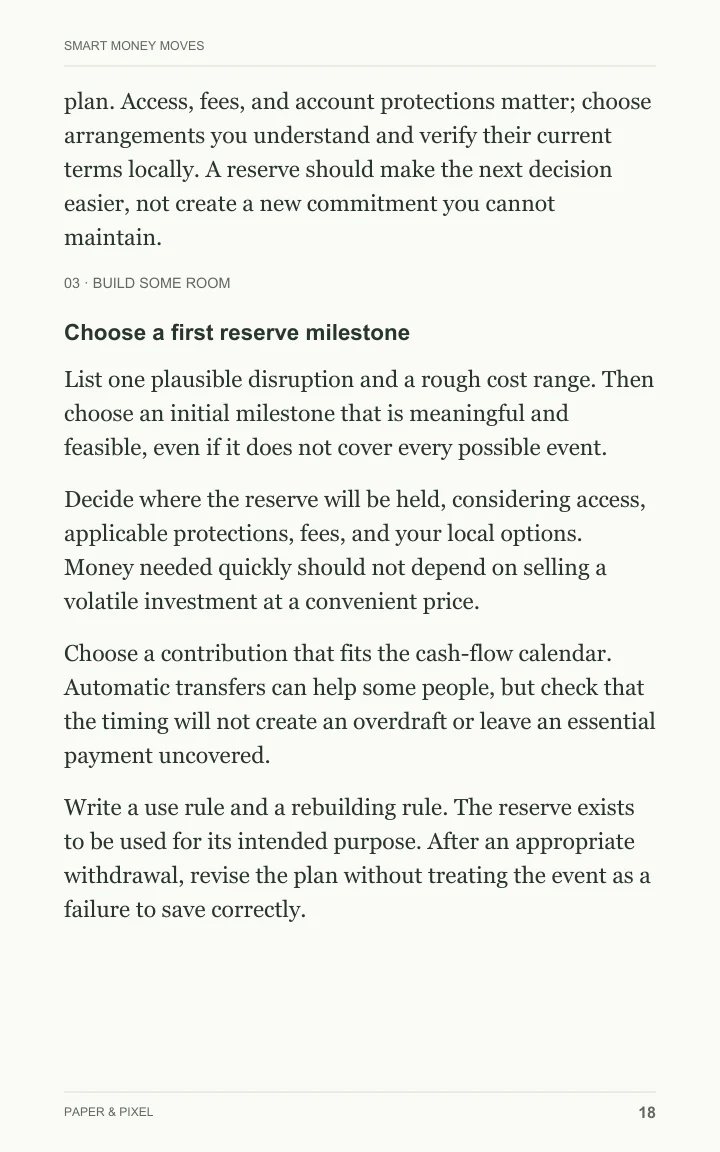
- A balance is a moment, not a plan
- Distinguish essential from automatic
- Savings can protect a decision
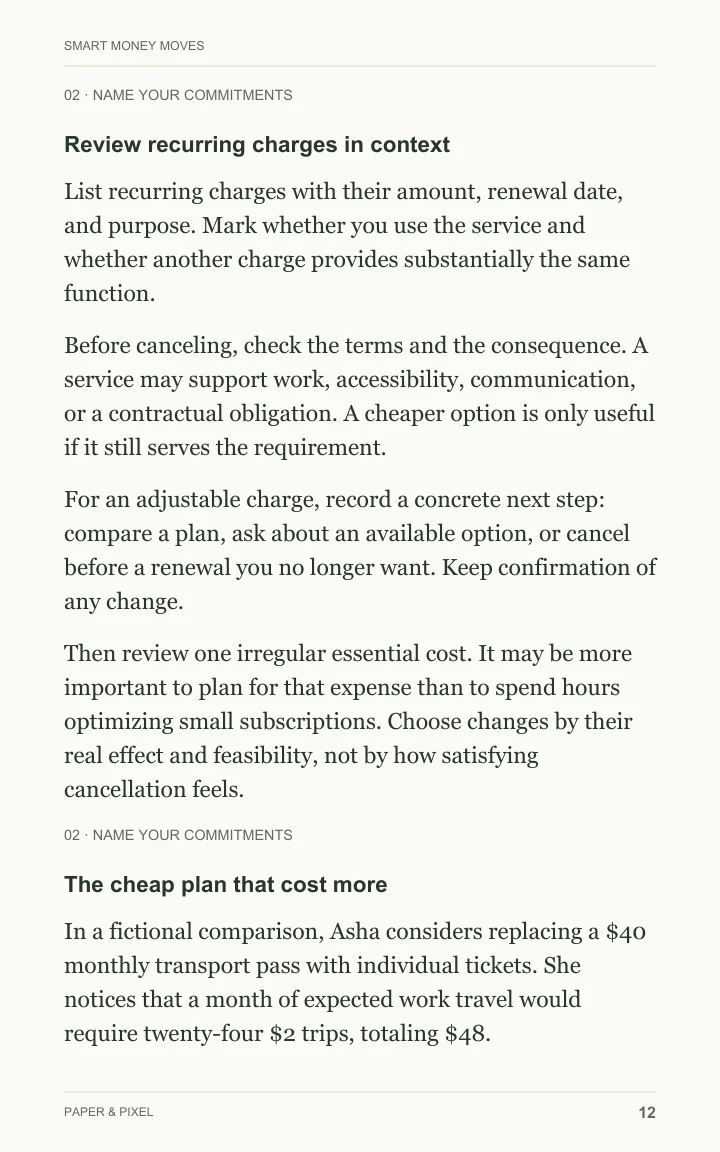
- Predictable does not mean monthly
- List terms before choosing a strategy
- Ask what the money will cost
- Turn a wish into a planning question
- Separate growth from certainty
- Make expectations discussable
- Keep the plan connected to reality
Also included: 10 reusable worksheets and a four-week practice plan. Page counts include the cover, front matter, worksheets, and editorial notes.
Worked lessons and a complete project
The expanded edition develops the chapter ideas through these detailed lessons:
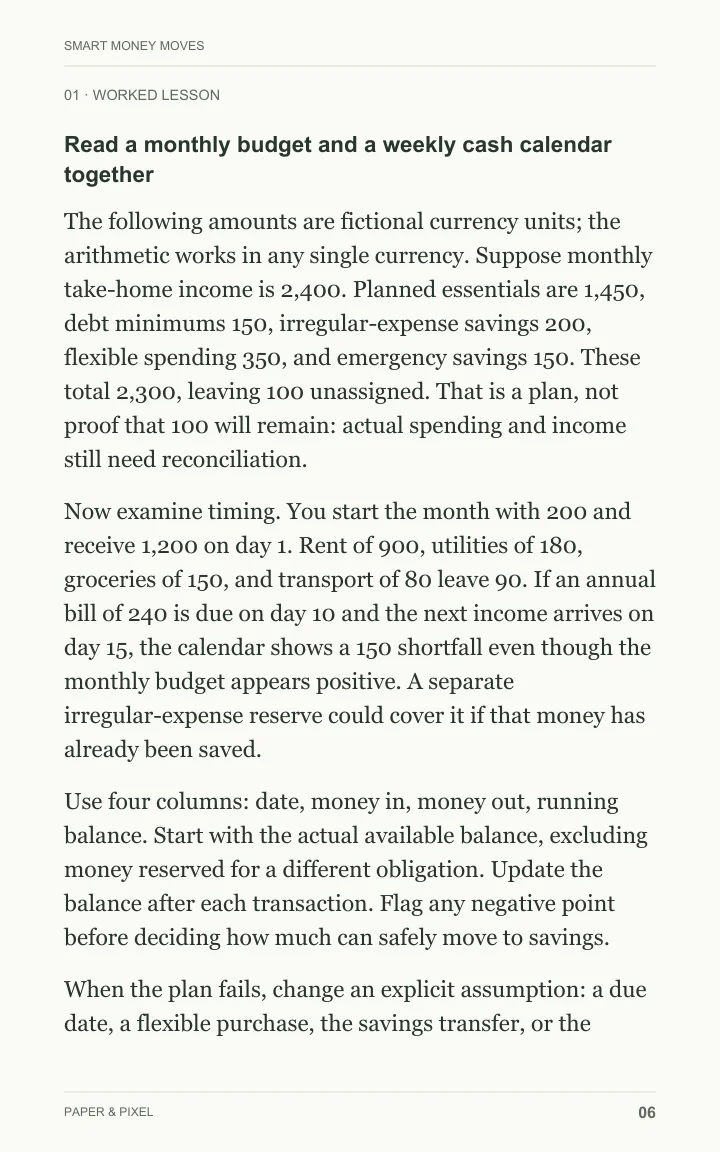
- Read a monthly budget and a weekly cash calendar together
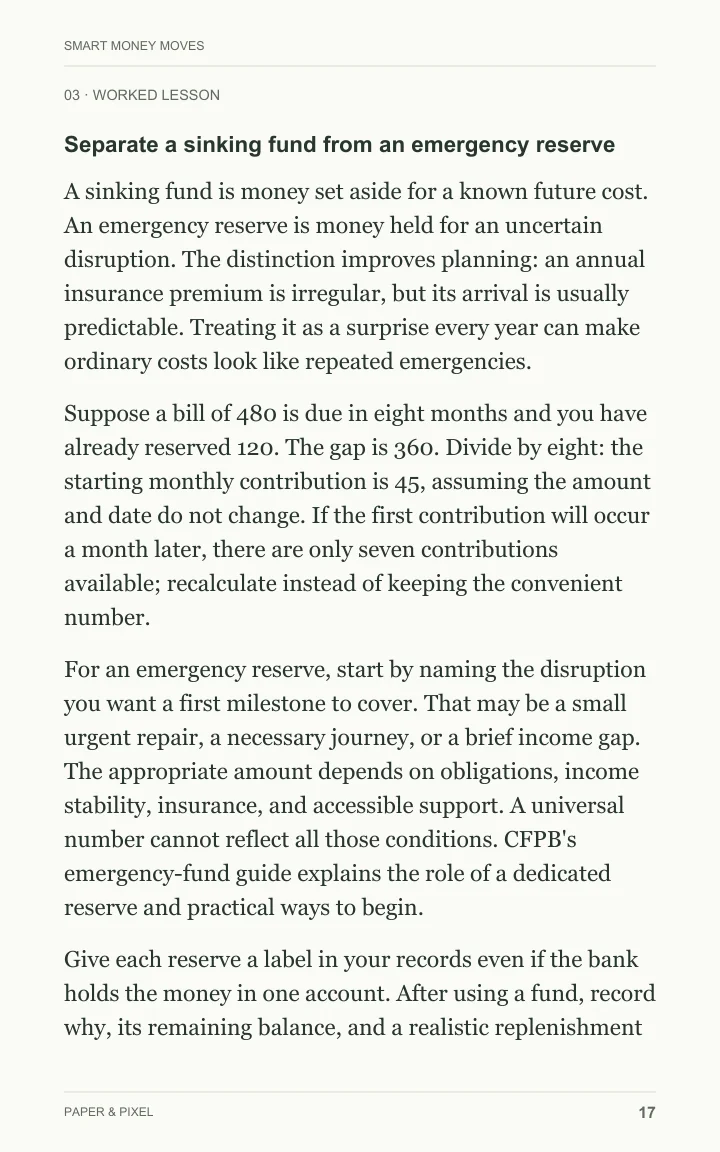
- Separate a sinking fund from an emergency reserve
- Compare debt strategies using the same assumptions
- Understand growth, inflation, and investment risk
- Reconcile a plan without blaming the person
Apply the ideas together
- Build a complete fictional money snapshot
- Stress-test the plan before choosing the remainder
- Close the month and prepare the next one
A subject glossary provides a quick reference while you work.
A small exercise to begin
Map expected income and committed expenses over the next two weeks, marking uncertain amounts instead of treating them as facts.
Edition and reading notes
Original editorial content. The PDF uses a fixed page layout with printable worksheet lines; it is not a fillable form or reflowable EPUB. No independent specialist review is claimed. Read our editorial policy.
This is general education, not personalized financial, legal, or tax advice. Examples are fictional and calculations may be simplified.
Keep following the thread.
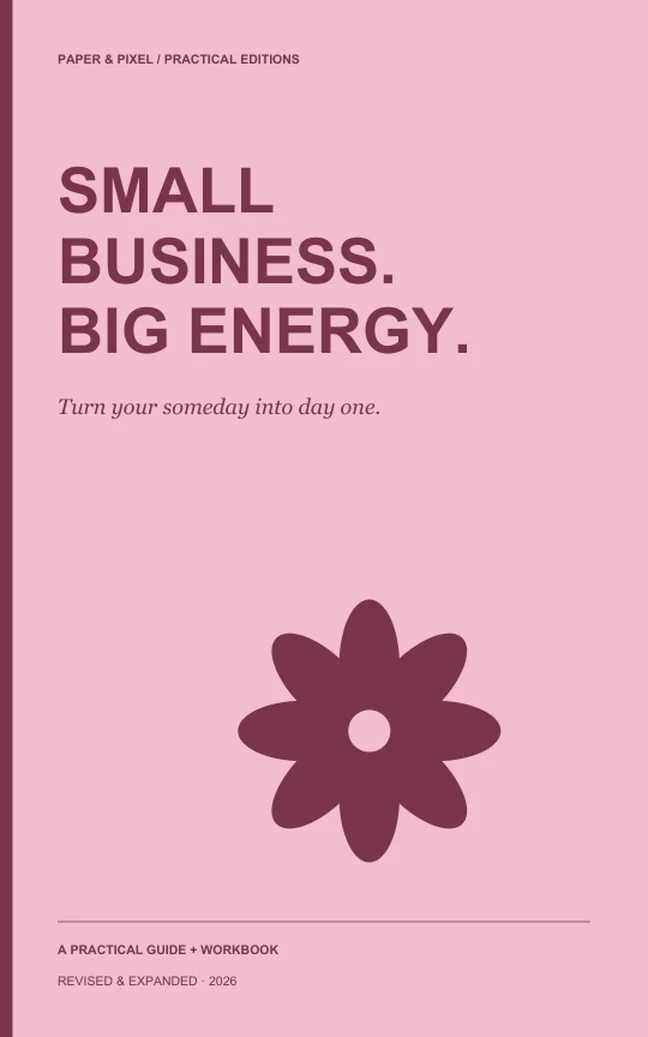
Business & Money
Small Business, Big Energy
Turn your someday into day one.
Read the sample & details ↗READER PERSPECTIVES
The reading experience.
Busy professional
“The structure feels calm and easy to follow. I would use the first worksheet before beginning a new project.”
Independent creator
“The strongest part is how quickly the ideas become usable. The chapter on “Distinguish essential from automatic” would be especially useful in a busy week.”
Curious beginner
“This reads like a thoughtful workshop rather than a long lecture. It feels designed to revisit, not just finish once.”
Weekend learner
“The chapter sequence makes the subject feel approachable. The exercise is specific enough to try without extra tools.”
Practical planner
“The examples keep the advice grounded in ordinary decisions. A reader could comfortably complete this in short sessions.”
Reflective reader
“The worksheets give each chapter a clear next step. The examples make the limits of the advice easy to understand.”
Small-team lead
“The tone is encouraging without promising an instant transformation. I like that the book leaves room for personal judgment.”
Habit builder
“The fixed-page design makes this pleasant to read and annotate. The printable pages would make a useful working companion.”
Visual thinker
“The short sections work well for focused reading sessions. The progression from observation to action feels natural.”
Note-taking reader
“The book respects the reader’s time and still explains the reasoning. This would suit someone who wants a concrete starting point.”
Self-directed learner
“The practical prompts help turn reflection into a useful experiment. The language stays clear even when the subject becomes detailed.”
Project starter
“The final project brings the separate lessons together clearly. The closing practice gives the book a satisfying sense of direction.”